
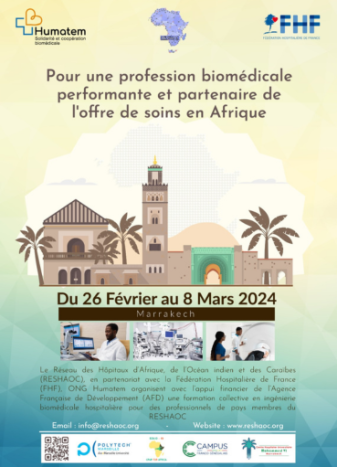
The Biomedical Engineering Department participated in the organization of an international training course for a high-performance biomedical profession as a partner in healthcare provision in Africa. This training course was created as part of the activities of the Réseau des Hôpitaux d'Afrique, de l'Océan indien et des Caraïbes (RESHAOC), supported by the Fédération des Hôpitaux de France (FHF), the Agence Française du Développement (AFD) and the NGO Humatem. It was dedicated to Engineers and Technicians ("acting Engineers") in hospitals or Ministries of Health in 11 African countries: Benin, Burkina Fasso, Cameroon, Comoros, Congo Brazzaville, Ivory Coast, Gabon, Guinea, Morocco, Senegal, Togo.
The team of trainers included specialists in the fields covered over 15 days:
- Référentiel national pour la gestion des opérations de maintenance et des investissements by Thierry Houngbo from the Ministry of Health in Cotonou, Benin.
- Imaging methods and quality control by Ibrahima Traore Sory, Head of Maintenance at Donka University Hospital, Guinea.
- Medical fluids - production plants and distribution systems: risks and regulations by Ismail El Amrani, Hospital Biomedical Engineer, CHU Mohamed VI de Marrakech, Morocco.
- Energy efficiency in the hospital sector (case studies) by Ahmed Idhammad, Ingénieur-PhD, Morocco.
- Organization and management of a biomedical team: missions, standards, human resources, life cycle of a medical device, CMMS (case study) by Benoît Pierre Ligot, Biomedical Engineer with the NGO Humatem, France.
- Quality approach to structuring biomedical missions and self-diagnosis tool (practical workshops) by Abderrahim Farid Benhagoug, Chief Biomedical Engineer, AP HM, France.
- Support for participants' presentations by Victor Ghomsi, Biomedical Engineer, Solid-19/Biomédical sans frontières, France.
- Ionizing radiation and radiation protection in hospitals by Nadine Candoni, Biomedical Engineering Department, Polytech Marseille, France.
Nadine Candoni was also invited to attend the Congress of the Moroccan Biomedical Society. Through this training program, the aim of Polytech Marseille's Biomedical Engineering Department is to build a network of reference biomedical engineers to improve biomedical maintenance in African hospitals, and to create Biomedical Engineering training programs, which are non-existent in many African countries.
